
Loading...
Lead retrieval has been part of Validar’s DNA for more than 20 years. During that time, the technology surrounding events has changed significantly. Mobile devices have replaced many dedicated scanners, CRM and marketing automation platforms have become more sophisticated, and exhibitors have access to more attendee data than ever before. But the purpose of lead retrieval hasn’t changed. Lead retrieval should help turn a face-to-face conversation into actionable data that sales and marketing teams can actually use. A badge scan by itself tells you that someone visited your booth. It doesn’t necessarily tell you what they were interested in, whether they are a strong prospect, what they want next, or how quickly your sales team should follow up. That is why Validar’s vCapture Lead Retrieval Suite is designed around flexibility, qualification, reliability, and integration. Here are four principles we believe should be at the core of an effective lead retrieval strategy. 1. CAPTURE THE VALUE OF THE CONVERSATION, NOT JUST THE CONTACT Collecting an attendee’s name, title, company, and contact information is useful but it only tells part of the story. The real value often comes from the conversation that happens before the badge is scanned. What product was the attendee interested in? Are they actively evaluating a solution? What is their purchasing timeline? Do they want a meeting, additional information, or a product demonstration? What role do they play in the buying process? If your team could have a meaningful conversation with every person who entered your booth, what questions would you want answered? Those questions should help shape your lead retrieval process. With vCapture, exhibitors can use customizable qualifiers to categorize and rank leads based on the information that matters to their organization. Validar's standard qualification workflow can also categorize leads as Hot, Warm, or Cold based on follow-up requirements, while customized configurations can align with an exhibitor's own sales process. Instead of sending sales a spreadsheet containing hundreds of virtually identical badge scans, exhibitors can provide additional context that helps teams understand who deserves attention first and why. That makes lead retrieval an extension of the conversation not simply a record that the conversation happened. 2. USE ONE LEAD RETRIEVAL STRATEGY ACROSS DIFFERENT EVENT ACTIVATIONS Not every valuable interaction happens at a traditional exhibition booth. An exhibitor or sponsor may be engaging attendees through several different experiences during the same event: * One-on-one product demonstrations * Sponsored presentations or theater sessions * Networking receptions * Hospitality areas * Customer meetings * Booth conversations * Offsite or private activations Each interaction may serve a different purpose, but the data should ultimately contribute to the same understanding of the attendee. A strong lead retrieval solution should therefore be flexible enough to support one-to-one and one-to-many interactions rather than forcing every activation into the same workflow. Validar’s vCapture suite is designed around this idea of flexibility. Depending on the event and exhibitor requirements, organizations can use dedicated devices, mobile licenses, custom qualifiers, their own lead retrieval technology, or configurations that integrate with broader event experiences. The objective isn't to add technology to every interaction. It is to create a consistent method for capturing meaningful engagement wherever it happens. When those interactions can be viewed as part of one larger attendee journey, exhibitors gain a much clearer picture of how people engaged with their brand throughout the event. 3. PLAN FOR THE INTERNET TO FAIL Convention centers, hotel ballrooms, temporary event spaces, and crowded exhibit halls are not always ideal environments for reliable connectivity. Lead retrieval shouldn't stop working because the Wi-Fi does. All vCapture solutions are designed to continue capturing leads offline and store the information locally until connectivity becomes available again. This means an exhibitor can continue scanning and qualifying attendees even when a device is disconnected or operating in airplane mode. Validar also builds redundancy into the badge itself. When Validar produces attendee badges, the QR code can contain partial contact information that allows exhibitors using vCapture to identify previously scanned attendees, edit records, and add notes even when connectivity is unavailable. Once the device reconnects, pending information can sync back to the Validar platform. This may not be the most exciting feature of a lead retrieval platform—but on a crowded show floor, reliability matters. The best event technology should support the experience without becoming the experience. 4. CONNECT LEAD RETRIEVAL TO THE REST OF YOUR MARKETING STACK Capturing a lead is only the beginning. The real business value comes from what happens next. Many organizations already have carefully designed processes inside platforms such as Salesforce, HubSpot, Marketo, Eloqua, and other CRM or marketing automation systems. Your event lead strategy should complement those workflows rather than create another disconnected database for your team to manage. For example, exhibitors using vCapture can create qualifiers and lead-ranking criteria that align with the fields and segmentation already used within their sales and marketing systems. With Validar's Salesforce integration, ranked and categorized vCapture leads can also be mapped into Salesforce, assigned to campaigns, deduplicated against existing records, and distributed using existing lead-assignment processes. That creates an opportunity to act on event data while it is still relevant. Instead of waiting until several days after the event to sort through every badge scan, teams can identify their highest-value prospects and prioritize follow-up accordingly. A salesperson working the event could potentially know which attendees requested a meeting or demonstrated strong purchase intent before the show is even over. That is a very different outcome from simply producing a list of names. LEAD RETRIEVAL SHOULD TELL YOU MORE THAN WHO STOPPED BY Events create thousands of interactions, but not every interaction carries the same value. The job of lead retrieval isn't simply to collect as many contacts as possible. It should help exhibitors understand: Who did we meet? What did they care about? How valuable was the interaction? What should happen next? That philosophy is at the core of the Validar vCapture Lead Retrieval Suite. By combining flexible lead capture, customizable qualification, offline reliability, and integration with the systems your sales and marketing teams already use, exhibitors can turn conversations on the show floor into structured data that drives action after and even during the event. Because ultimately, the value of a lead isn't in the scan. It's in what your team is able to do with it. Want to learn how vCapture can help your exhibitors capture, qualify, and act on better event leads? Explore Validar's vCapture Lead Retrieval Suite or contact our team to discuss your next event.
B2B events can be one of the most effective ways to generate product interest, deepen customer relationships, and create meaningful sales opportunities. Where else can attendees: * See a hands-on product demo from a subject matter expert * Meet customers and peers with similar challenges * Attend live educational sessions around topics that matter to them * Share meals and conversations with people in similar roles and industries * Explore new products, solutions, and ideas in one place The challenge is what happens after the event. Attendees may have spent several days engaging with your brand, consuming content, speaking with experts, attending sessions, and interacting with exhibitors. But too often, very little of that behavior makes it into the hands of the sales team. The result? A salesperson follows up and starts with something like: “How was the event?” or “Did you happen to attend any of our sessions?” Now the attendee has to rehash an experience your organization already had the opportunity to understand. A better approach is to use attendee behavior and attendee-provided preferences to give your sales team context before they ever make the first post-event call. Even better, give attendees some control over what happens next. Here are four ways to create a better follow-up experience for both your sales team and your attendees. 1. GIVE YOUR SALES TEAM THE ATTENDEE’S ENTIRE EVENT JOURNEY Many organizations push basic event attendance into their marketing or CRM systems. That is useful, but it only answers one question: Did they attend? The bigger opportunity is understanding what they did while they were there. If an attendee participated in several sessions around the same product area, visited a relevant booth, completed an evaluation, or requested additional information, that context can dramatically improve the quality of the follow-up conversation. Instead of: “I saw you attended our conference.” Your sales team can have a much more relevant conversation based on what that person actually chose to engage with. For example, knowing that a prospect attended two sessions about cybersecurity, rated one of them highly, and visited a related product demonstration provides far more context than an attendee list ever could. Session attendance tracking can be especially valuable here. When session participation is connected back to the attendee record, your sales team can understand which content their customers and prospects consumed and use those interests as a natural starting point for the conversation. The goal is simple: Do not make attendees explain an experience your organization already has data about. Give your sales team the context first. 2. USE SESSION EVALUATIONS TO IDENTIFY WHO WANTS THE CONVERSATION TO CONTINUE Session evaluations are often treated purely as a way to measure speaker or content performance. They can do much more. A well-designed evaluation can also help attendees tell you what they want to happen next. For example, after a session, you might ask: “Would you like to speak with a subject matter expert about this topic?” The answer can be as simple as yes or no. That single question can help segment the session audience into attendees who enjoyed the content and attendees who are actively interested in continuing the conversation. Now your marketing and sales teams have significantly more context. Instead of assuming everyone in the room is a lead, you are allowing the attendee to raise their hand. This can be particularly useful during the event itself. If an attendee expresses interest in speaking with someone, that information can potentially be routed quickly enough for the conversation to happen while the attendee is still onsite and the topic is fresh. We have seen brands use session evaluations to help generate meetings for their sales teams during live events. There is one important rule, though: Do not ask the question unless you are prepared to respond. If an attendee actively asks to speak with an expert and then hears nothing for several days, the experience can quickly become frustrating. Giving attendees control works best when your organization is prepared to act on the information they provide. 3. LET ATTENDEES OPT IN—OR OUT—OF SALES FOLLOW-UP Not every interaction at an event represents buying intent. Your sales team knows this. Your attendees definitely know this. The challenge is that the data often does not. Imagine an attendee walks into your booth because you are giving away a popular promotional item. Their badge gets scanned, and suddenly they are treated the same as someone who spent 20 minutes discussing a product challenge with your team. Those are two very different interactions. Yet without additional context, both may enter your sales process as leads. That creates a bad experience on both sides. Salespeople do not want to repeatedly contact someone only to discover that the attendee was interested in a giveaway rather than the product. Attendees do not want to receive multiple follow-up emails and calls about something they never expressed interest in. This is where attendee choice and marketing automation can work together. When capturing booth traffic or other attendee behavior, give attendees the ability to indicate whether they want continued communication. For example: * Yes, I would like someone to contact me * Send me more information * I am interested, but not ready for a sales conversation * No follow-up needed The same principle applies outside the booth. If a session topic resonates with an attendee, give them a simple way to say: “I want to learn more.” If they do not want follow-up, allow them to communicate that as well. This removes unnecessary work from your sales team while creating a more respectful experience for attendees. It also improves the quality of the leads that ultimately reach sales. 4. CAPTURE FEEDBACK THAT ALIGNS WITH THE INTENT OF THE SESSION Not every session exists for the same reason. Some sessions are designed to educate. Others are designed to build awareness. Some are intended to strengthen customer relationships. And some are specifically designed to generate interest in a product or solution. Your evaluation questions should reflect that intent. If the objective of a session is purely educational, questions around content quality, relevance, and speaker effectiveness may be enough. But if the purpose of the session is to generate demand, your feedback should help determine whether that actually happened. You might ask: * Did this session increase your interest in this topic? * Would you like additional information? * Are you currently evaluating a solution in this area? * Would you like to speak with a subject matter expert? * Would you be interested in a demonstration? These questions do more than measure satisfaction. They help connect the purpose of the session with the behavior that follows it. That is an important distinction. A session can receive excellent ratings without generating demand. Another session may directly influence attendees to request meetings, demos, or additional information. Neither outcome is inherently better the right measurement depends on what the session was designed to accomplish. Start with the intent of the experience. Then capture the feedback that tells you whether that intent was achieved. BETTER FOLLOW-UP STARTS WITH BETTER CONTEXT The best post-event sales conversations should not feel like cold outreach. The attendee has already interacted with your organization. They may have attended your sessions, spoken with product experts, visited your booth, completed evaluations, or requested additional information. Your job is to make sure those interactions do not disappear when the event ends. By connecting attendee behavior with attendee preferences, you can give sales teams the context they need while giving attendees more control over how and whether the conversation continues. That creates a better experience for everyone. Sales teams spend more time with people who actually want to engage. Marketing teams gain a clearer picture of which event activities are creating demand. And attendees receive follow-up that is more relevant to the experience they actually had. If you are struggling to connect your event marketing efforts with sales outcomes, Validar was built with that challenge in mind. Our platform helps organizations capture attendee behavior, session participation, feedback, lead information, and other event interactions so that valuable event context can continue working long after the event ends. Contact Validar to learn how you can create a more connected event-to-sales experience.
.png&w=3840&q=75)
Many events are designed to do more than educate attendees—they're built to generate demand, influence buying decisions, and create opportunities for sales conversations. Yet despite significant investments in registration, content, speakers, exhibitors, and attendee engagement, one challenge remains consistent across many organizations: Event data often stops with the event team. At Validar, we work with some of the most sophisticated event marketers in the world, and we're continually impressed by how event data is used to measure engagement and improve future experiences. However, one recurring opportunity stands out: Why isn't more of that data being shared with the sales team? The reality is that event marketers are often creating far more value than their organizations realize. By connecting attendee behavior to your sales and marketing systems, you can turn event engagement into actionable intelligence that helps sales teams prioritize outreach, personalize conversations, and accelerate pipeline growth. Here are four ways to maximize the value of your event data with your sales team in mind. 1. MAKE SESSION ATTENDANCE DATA PART OF YOUR MARKETING STACK Knowing who attended a session is useful. Knowing what they attended, how many sessions they participated in, and how that behavior aligns with their interests is even more valuable. Many organizations already use digital behavior to score leads and personalize outreach. Marketing automation platforms track website visits, video views, email engagement, and pricing page activity to better understand buyer intent. Why should events be any different? Session attendance is one of the strongest indicators of interest available during an in-person event. When attendance data is integrated into your CRM or marketing automation platform, sales teams gain valuable context about what topics, products, or solutions resonated with each attendee. Instead of viewing session attendance as a reporting metric, treat it as a behavioral signal that helps drive more relevant sales and marketing conversations. 2. DON'T STOP AT ATTENDANCE CAPTURE INTENT THROUGH SESSION FEEDBACK Attendance tells you what someone was interested in. Feedback tells you why. Imagine a prospect attends a session announcing a new product release. The first question most sales representatives will ask is: "What did they think?" Session evaluations provide the perfect opportunity to gather that information directly from attendees. Consider including questions that help identify intent, such as: * Did this session increase your interest in this solution? * Would you like to learn more? * Would you like to speak with a product expert? * Are you interested in scheduling a follow-up conversation? If a session is intended to generate demand, there may be no better way to capture interest than simply asking attendees if they'd like to take the next step. 3. MAKE IT EASY FOR ATTENDEES TO REQUEST A CONVERSATION Have you ever watched a popular speaker finish a presentation only to be surrounded by a line of attendees waiting to ask questions? Now consider how many people never joined that line because they had another session to attend, needed to leave the room, or simply didn't want to wait. Those missed interactions can represent missed opportunities. Session evaluations and attendee engagement tools can provide a simple alternative. Allow attendees to request a meeting, ask for more information, or connect with a subject matter expert directly from their event experience. Even better, encourage speakers to mention this option at the beginning and end of their presentations. When attendees can express interest with a few clicks, your organization captures valuable intent data while creating a better attendee experience. Just make sure those requests flow directly into your marketing and sales systems so follow-up happens quickly. 4. GIVE ATTENDEES CONTROL OVER POST-EVENT FOLLOW-UP Not every lead is created equal. The quality of a conversation, the attendee's level of interest, and their desired follow-up all matter when determining how sales should engage after an event. When capturing leads at exhibitor booths or sponsor activations, use qualifiers to categorize conversations and identify next steps. This helps sales teams prioritize outreach and tailor messaging based on actual interactions. If you're offering giveaways, contests, or incentives to drive booth traffic, consider including clear opt-in and opt-out options as part of the lead capture process. Giving attendees control over how they're contacted creates a better experience, improves compliance, and helps ensure your sales team is focusing on prospects who genuinely want to continue the conversation. FINAL THOUGHTS Event Marketers Create More Revenue Impact Than They Often Receive Credit For Today's event programs generate a tremendous amount of valuable attendee intelligence. Session attendance, engagement data, evaluations, lead qualifiers, and meeting requests all provide insights that can help sales teams have more productive conversations. The key is making sure that data doesn't remain isolated within the event team. When event engagement data is connected to your broader marketing and sales ecosystem, your organization gains a clearer picture of buyer intent, improves follow-up, and unlocks additional value from every event. At Validar, we believe many event marketers are delivering far more value than their organizations realize. The opportunity is simply making that value visible. Ready to help your sales team get more from your events? Request a demo today and learn how Validar helps organizations capture, connect, and activate attendee engagement data throughout the event journey.
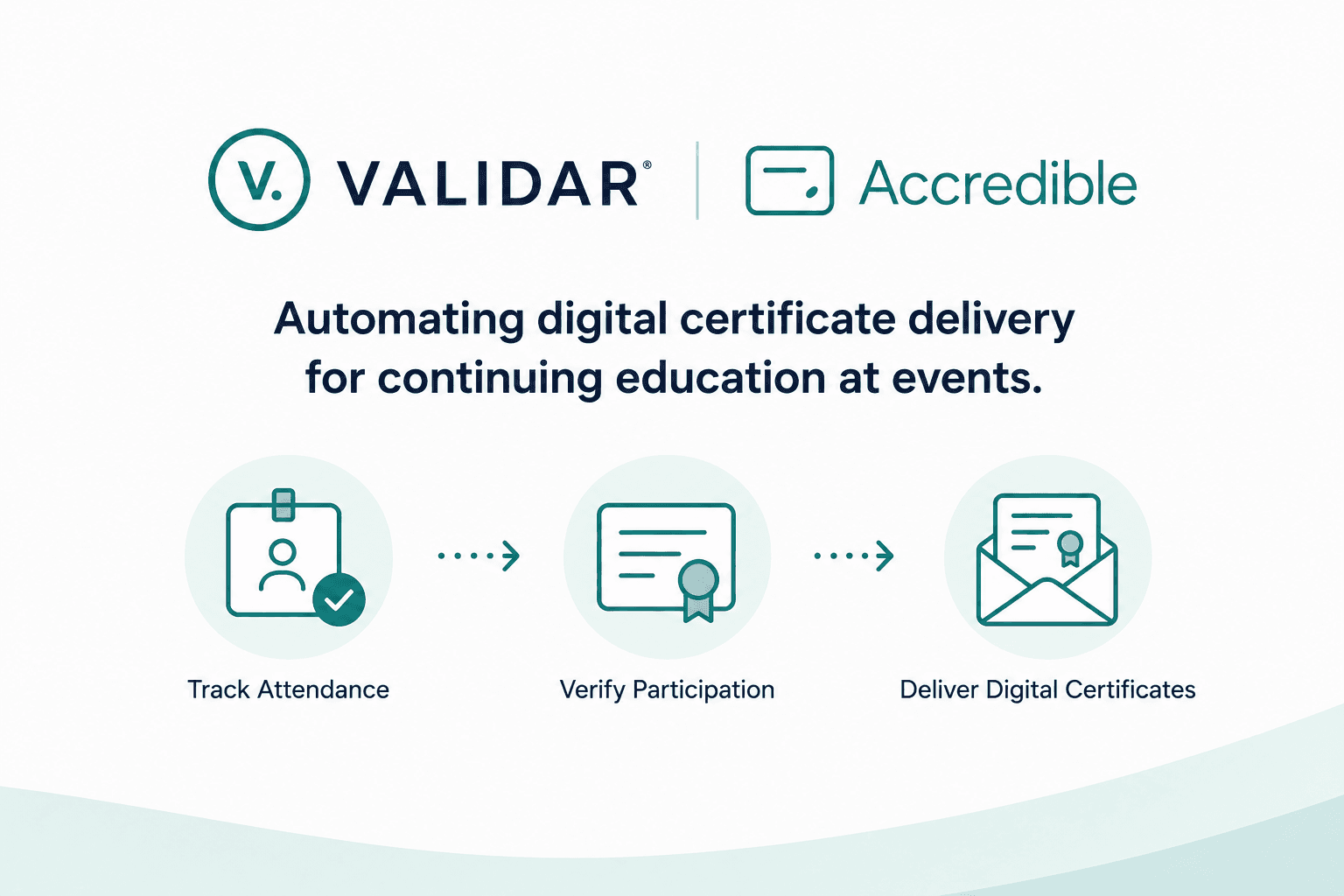
Continuing education programs are one of the biggest value drivers for conferences, association events, healthcare meetings, and professional development programs. But for many organizers, delivering CE certificates after the event still involves hours of manual reporting, spreadsheet cleanup, and attendee verification. That process is changing. Validar recently announced a new integration with Accredible that helps event organizers automate digital certificate delivery based on verified attendee participation. Read the full announcement here: Validar Announces Integration with Accredible to Automate Digital Certificate Delivery for Continuing Education at Events [https://www.prweb.com/releases/validar-announces-integration-with-accredible-to-automate-digital-certificate-delivery-for-continuing-education-at-events-302773203.html?utm_source=chatgpt.com] WHY CONTINUING EDUCATION TRACKING MATTERS For organizations running accredited sessions, verifying attendance accurately is critical. Whether attendees are earning CME, CEU, CLE, or other professional education credits, organizers need a reliable way to confirm participation before issuing certificates. Traditionally, this process can involve: * Manual attendance reconciliation * Spreadsheet exports and imports * Delayed certificate delivery * Administrative overhead after the event * Potential inaccuracies from self-reported participation As events scale, these workflows become increasingly difficult to manage. HOW THE VALIDAR + ACCREDIBLE INTEGRATION WORKS The integration connects Validar’s session attendance tracking technology directly with Accredible’s credentialing platform. Using technologies like: * Badge scanning * RFID tracking * BLE session attendance tracking Validar captures verified attendee participation in real time. That data can then automatically trigger credential and certificate delivery through Accredible. The workflow becomes simple: 1. Track attendee participation 2. Verify attendance automatically 3. Deliver digital certificates instantly This creates a faster, more accurate experience for both organizers and attendees. BENEFITS FOR EVENT ORGANIZERS Reduce Manual Administrative Work Automating certificate delivery removes hours of post-event processing and manual verification. During the 2026 ABVP Symposium, the integration reportedly saved organizers approximately 60 hours of post-event work. Improve Accuracy Because attendance data is captured directly from session participation, organizers can reduce errors and improve confidence in CE reporting. Deliver a Better Attendee Experience Attendees receive digital credentials faster and can immediately access, download, or share them online. Provide More Measurable Event Value By combining attendance tracking with credential delivery, organizers gain more visibility into engagement and educational participation across their events. SUPPORTING SMARTER EVENT EXPERIENCES At Validar, the goal has always been to help organizers better understand attendee behavior and deliver more measurable value from their events. Integrations like this extend that vision by connecting verified attendance data directly into the systems attendees and organizers rely on most. As continuing education programs continue evolving, automation and real-time event data will play an even bigger role in improving operational efficiency and attendee satisfaction. Learn more about the announcement here: Read the Full Press Release [https://www.prweb.com/releases/validar-announces-integration-with-accredible-to-automate-digital-certificate-delivery-for-continuing-education-at-events-302773203.html?utm_source=chatgpt.com] READY TO LEARN MORE? If your organization is looking to streamline continuing education workflows, improve attendance verification, and automate certificate delivery, Validar can help. Request a Demo [https://validar.com/demo?utm_source=chatgpt.com]
WHY EXHIBITOR VALUE IS THE BIGGEST MISSED OPPORTUNITY AT EVENTS Event organizers put enormous effort into attracting sponsors and exhibitors—but too often, the value delivered to them doesn’t match the investment they make. Booth space alone is no longer enough. Exhibitors today expect: * Measurable ROI * High-quality, actionable data * Seamless integration into their sales and marketing workflows When those expectations aren’t met, it doesn’t just impact exhibitor satisfaction—it limits your ability to increase sponsorship revenue and long-term partnerships. The opportunity? Leverage your event tech investment in tracking exhibitor engagement, and content consumption to create more value and give you more to monetize. THE PROBLEM: ONE-SIZE-FITS-ALL DOESN’T WORK ANYMORE Many events still rely on basic, app-based lead retrieval or generic badge scans to exchange contact information between attendees and exhibitors. That approach creates several issues: * Limited flexibility for different exhibitor needs * Inconsistent data quality * Poor post-event follow-up capabilities * Minimal differentiation between sponsorship tiers In reality, exhibitors vary widely: * Some want simple lead capture * Others need deep integration with Salesforce or marketing automation tools * High-investment sponsors expect advanced insights and control If your offering doesn’t scale with those needs, you’re leaving both value and revenue on the table. A BETTER APPROACH: FLEXIBLE LEAD RETRIEVAL THAT SCALES WITH INVESTMENT Validar’s vCapture Lead Retrieval Suite is designed around one core principle: Exhibitors should have the flexibility to choose the solution that works best for them. This flexibility unlocks both better exhibitor outcomes and clear monetization paths for event organizers. What That Looks Like in Practice: * Dedicated devices for fast, reliable lead capture * Custom qualifiers to score and prioritize leads in real time * Bring-your-own lead retrieval support for exhibitors with existing tech stacks * Direct Salesforce integration for immediate post-event action At one large-scale event, this approach supported: * 884 total licenses * 174 dedicated devices * Multiple Salesforce-integrated deployments * Custom qualifier configurations * Exhibitors using their own integrated solutions That level of flexibility is nearly impossible to achieve with a standard mobile app alone. RELIABILITY MATTERS MORE THAN YOU THINK One of the biggest frustrations exhibitors face is unreliable lead capture. Wi-Fi drops. Apps crash. Data gets lost. Validar’s approach ensures: * Lead capture works even in airplane mode * Data syncs automatically once connectivity returns * No missed opportunities due to technical issues This reliability isn’t just a feature it’s a trust builder with your exhibitors. TURNING DATA INTO REAL EXHIBITOR VALUE Capturing leads is just the beginning. The real value comes from delivering actionable datasets that help exhibitors understand performance and drive follow-up. Validar automatically provides three key datasets: 1. Booth Leads Fully scored and categorized based on custom qualifiers so sales teams know exactly who to prioritize. 2. Session Attendance Insight into which attendees engaged with sponsored or exhibitor-led sessions. 3. Session Evaluations & Meeting Requests Often the most valuable dataset capturing intent, sentiment, and direct follow-up opportunities. This transforms exhibitor participation from lead collection → pipeline generation. WHERE MONETIZATION COMES IN When you offer scalable, flexible solutions, you unlock tiered pricing opportunities. Instead of a flat exhibitor package, you can: * Charge based on number of licenses * Offer premium pricing for dedicated devices * Monetize advanced data and integrations * Align pricing with booth size and investment level Important distinction: Unlike mobile apps that grant broad access to all booth staff, licenses can be activated and deactivated as teams rotate through shifts—giving exhibitors more control and allowing you to price access more strategically. Example: * Larger booths = more staff → more licenses → higher revenue * Premium sponsors = deeper integrations → higher value packages This creates a direct correlation between exhibitor investment and event revenue. BEYOND LEAD RETRIEVAL: A COMPLETE EXHIBITOR VALUE ECOSYSTEM Lead retrieval is just one part of the equation. When combined with: * Session tracking * Dynamic evaluations * Meeting requests driven by content …you create a full picture of attendee engagement. This allows exhibitors to: * Understand what content resonated * Identify high-intent prospects * Follow up with precision And it allows you to position your event as: A measurable demand-generation engine—not just a marketing expense. THE BIGGER PICTURE: STRENGTHENING LONG-TERM PARTNERSHIPS When exhibitors see clear ROI, three things happen: 1. They renew 2. They upgrade their sponsorship 3. They advocate for your event internally That’s how you move from: * One-time transactions → Long-term revenue growth FINAL THOUGHTS Exhibitors aren’t just participants they’re key revenue drivers for your event. Delivering more value to them isn’t just good service it’s a strategic growth opportunity. By offering flexible, reliable, and data-rich solutions like Validar’s vCapture, you can: * Improve exhibitor satisfaction * Increase sponsorship revenue * Differentiate your event in a crowded market READY TO DELIVER MORE VALUE TO YOUR EXHIBITORS? If you’re looking to elevate your exhibitor experience and unlock new monetization opportunities, Validar can help. 👉 Request a demo: https://validar.com/demo [https://validar.com/demo]
We take great pride in our ability to measure content effectiveness and provide meaningful insights that drive better event outcomes. Many teams underestimate how much value they are leaving on the table when session evaluations rely solely on mobile app adoption. Validar’s EventHub® Attendee Tool is designed to address this gap and deliver measurable impact. Here’s why organizations choose EventHub® for session evaluations: 1. FEEDBACK FROM MULTIPLE CHANNELS, NOT JUST THE APP (MOBILE APP, PHONE, AND EMAIL) When relying on a mobile application, session evaluation response rates are directly tied to app adoption—which can vary significantly depending on the event. * Without strong promotion or incentives, adoption rates often reach only 20–30% of total attendance * With effective promotion (e.g., exclusive content, gamification, on-site messaging, or incentives like contests or rewards), 55–65% is considered a strong benchmark This means a significant portion of attendees may never provide feedback if the mobile app is the only channel available. Blach Hat feedback via email.png [https://validar.com/media/Blach Hat feedback via email.png] Organizations such as Black Hat and Game Developers Conference partner with Validar for this reason. EventHub enables feedback collection during sessions via mobile app or QR access, as well as follow-up outreach at the end of each day and post-event to ensure all attendees have the opportunity to respond. 2. YOU DO NOT NEED A MOBILE APPLICATION WITH EVENTHUB® Not all events are well suited for a mobile application. One-day events, non-fee-based programs, or smaller conferences with limited session tracks may not justify the cost or complexity. With EventHub®, attendees can simply scan a QR code, authenticate, and submit feedback in real time during each session. When paired with post-event email outreach, this creates a highly effective and accessible feedback strategy. Event Facing QR Code.png [https://validar.com/media/Event Facing QR Code.png] 3. VALIDAR SCORES SESSION CONTENT USING A LIKERT SCALE EventHub leverages a standardized Likert scale to evaluate session performance. While this approach is widely recognized, its true value lies in how it enables consistent benchmarking across your entire program. This allows event organizers to: * Compare sessions against one another * Identify top-performing and underperforming content * Evaluate speaker effectiveness * Make more informed programming decisions for future events Likert Scale.png [https://validar.com/media/Likert Scale.png] 4. ENABLE ATTENDEES TO REQUEST FOLLOW-UP WITH CONTENT OWNERS EventHub allows attendees to opt in to connect with subject matter experts through a simple yes-or-no question tied to each session. Responses indicating interest can be automatically captured and distributed as a distinct lead dataset. This is especially valuable for: * Exhibitors sponsoring sessions * Sales teams supporting demand generation programs * Event organizers looking to extend engagement beyond the session If you have a moment, the short demo at the 2:55 mark in this video [https://vimeo.com/1101639937/500544cb70?share=copy&fl=sv&fe=ci] highlights this capability in action. New Lead Dataset.png [https://validar.com/media/New Lead Dataset.png] 5. GAMIFICATION THROUGH THE MY SCORE ACTIVITY VIEW Validar’s EventScore platform enhances engagement by incentivizing attendee participation across sessions, exhibitors, and evaluations. Through the My Score tab, attendees can view their activity, track engagement points, and see how they rank on the event leaderboard. This visibility encourages continued interaction and has proven to significantly improve session evaluation response rates when properly promoted. Insert MyScore tab.png [https://validar.com/media/Insert MyScore tab.png] We would be happy to discuss how this approach could support your upcoming programs. Please select a time here [https://calendly.com/vkippes/30min?month=2026-03] if you would like to learn more
.png&w=3840&q=75)
Most event teams already know events create demand. The real challenge is proving how demand was created and then using that truth to power better experiences, better exhibitor outcomes, and faster, more personalized follow-up. Event marketers are not getting the credit they deserve for the demand that they create when event tech is not deployed ideally. The ideal Event Tech deployment: not “more technology,” but a connected dataset that captures each attendee’s journey from arrival to engagement to next steps so Marketing Operations and Sales can act on it with confidence. Because when your event data is complete, you can answer five questions that define modern event ROI. THE 5 QUESTIONS EVERY EVENT TEAM SHOULD BE ABLE TO ANSWER If you can answer these on an individual attendee basis, you can stop guessing and start activating: * Of those that registered, who attended? * What content did that attendee consume? * What impact did that content have and did it generate renewed interest? * Did they sit through a one-on-one demo or key conversation? * What impact did that one-on-one demo have and did it generate renewed interest or next steps? Why do these questions matter so much? Because the value of an event isn’t just attendance. It’s the sequence of behaviors that follow attendance: sessions attended, feedback submitted, quality networking, meetings requested, booth conversations, and the intent signals that tell you who needs attention now. And when follow-up is the goal, time matters. Responding within minutes, or live during the event rather than waiting, dramatically improves your odds of closing a sale. Events are one of the few channels where you can capture high-confidence, high-context signals in person. The ideal deployment makes sure those signals don’t get lost. WHY “ONE DATASET” BEATS “MANY TOOLS” In most event stacks, the data ends up fragmented: * Registration tells you who planned to show up * Check-in tells you who actually showed up * Session tools tell you what topics are resonating and top of mind * Surveys tell you what people thought and provide an opportunity to reach out to content owners. * Lead capture tells you who had a conversation and the value of that conversation * Sales notes tell you more specifics about each meaningful conversation When these systems don’t connect, two problems appear: 1. Your reporting becomes silo’d. You can report attendance, but not intent. 2. Your follow-up becomes generic. Reps don’t know why someone is worth prioritizing. The ideal deployment solves this by building one evolving attendee record so every new interaction enriches the same journey. image (15).png [https://validar.com/media/image (15).png] THE VALIDAR PLATFORM: 5 PRODUCTS BUILT TO COMPLETE THE JOURNEY Validar’s platform is designed to capture an attendee’s entire journey so it can be treated by Marketing Operations and Sales during the event and after. Here are the five product offerings that work together to do it: * vCheckin Onsite Registration * Validar Session Attendance Tracking (active + passive) * EventHub® Attendee Tool (evaluations + meeting requests) * vCapture Lead Retrieval Product Suite * EventScore Engagement Tool Now let’s map the five questions to the tools that answer them. QUESTION → PRODUCT MAPPING 1) When did an attendee arrive? Product: vCheckin Onsite Registration Your attendee journey starts the moment someone shows up. vCheckin is built to deliver a fast, high-quality registration experience while producing the operational data event teams rely on: * Of those that registered, who actually attended (by attendee type)? * How many attendees registered onsite (walk-ons)? * How many registered attendees did not attend (no-shows)? This isn’t “nice-to-have” data. It’s how you measure real attendance, protect exhibitor value, and forecast staffing and onsite workflows accurately. And once arrival is tracked cleanly, the rest of the journey becomes measurable. 2) What content did that attendee consume? Products: vCheckin + Session Attendance Tracking (active + passive) You invest heavily in content keynotes, breakouts, activations, workshops, sponsored sessions because content is where education turns into demand. Session attendance tracking helps you measure that consumption in two common ways: * Active tracking (e.g., QR scans at doors, checkpoints, or session moments) * Passive tracking (technology-assisted detection such as RFID or BLE, depending on deployment needs) The key point for event teams isn’t the acronym it’s the outcome: You want reliable, session-level proof of what each attendee actually consumed. When you deploy vCheckin + session tracking, your live dataset starts answering: * When did they arrive? * What did they consume? * How consistently did they engage across tracks, days, or topics? That’s the foundation for segmentation. 3) What impact did that content have and did it generate renewed interest? Product: EventHub® Attendee Tool Attendance alone doesn’t tell you whether content landed. Impact does. EventHub® is built to capture that impact through session evaluations and attendee-facing feedback that is designed to benchmark your content, and allow the audience to continue the conversion with content owners. Why impact measurement is hard (and how to solve it) Many event organizers rely on mobile apps for evaluations, but response rates are tightly connected to app adoption. Industry benchmark guidance often cites a wide range: adoption may be 20–30% without strong promotion, while 55–65% can be a solid benchmark with good promotion and incentives. That’s exactly why the ideal deployment includes a strategy that doesn’t depend on a single channel. EventHub is built around four practical advantages 1) Promote feedback through two mediums (mobile + email) Relying only on an in-app flow limits your audience to adopters. Multi-channel outreach gives you broader coverage and better representativeness. Response rates vary substantially by channel, which is why mixing approaches is a common best practice in feedback programs. 2) You don’t need a full mobile app to collect meaningful evaluations Not every event warrants the cost, build, or overhead of a dedicated event app, especially one-day events, smaller programs, or events with limited tracks. With EventHub, you can enable in-the-moment feedback via a simple workflow: * Scan a QR code * Authenticate * Submit feedback live during each session EventHub can also be integrated into your favorite mobile application. We always recommend you augment your feedback marketing efforts with an end of day and post-event email. You’ll have a much better opportunity to increase session evaluation response rates following this method. 3) Benchmark sessions using Likert scoring Likert-type scales are a common, standardized way to quantify attitudes and satisfaction through a graded response key (e.g., strongly disagree → strongly agree). This lets event teams quickly identify: * Top sessions (repeat, expand, sponsor) * Bottom sessions (fix, retire, coach) * Track-level performance (what themes resonate) 4) Allow session attendees to request meetings with content owners This is where impact becomes action. EventHub can capture a simple “yes/no” meeting request then treat “yes” responses as a unique lead dataset tied to specific content. So instead of only knowing: * “They attended Session A” You also know: * “They attended Session A and opted in to continue the conversation.” That’s renewed interest, captured cleanly. 4) Did they sit through a one-on-one demo or key conversation? Product: vCapture Lead Retrieval Suite For demand-gen events, the exhibit floor (or sponsor activations) is where most of the highest-value one-on-one conversations happen. vCapture is built to help exhibitors and sales teams capture those interactions in a structured way so follow-up reflects reality, not guesswork. A robust lead capture workflow should do more than store contact info. It should allow teams to: * Rank or categorize leads based on criteria that matches their sales motion * Capture notes that add context (use case, timeline, objections) * Identify which leads are “skim-the-top” priorities vs. longer-tail nurture That’s how you avoid the classic post-event problem: “We have 800 leads… and no idea which 60 matter.” 5) What impact did that one-on-one have—and did it generate renewed interest or next steps? Products: vCapture + Custom Qualifiers + Lead Import for AppExchange Impact can show up in multiple ways: * A lead is marked high priority * A meeting is booked * A follow-up is explicitly requested * Engagement patterns suggest strong interest (multiple relevant sessions + booth interaction) This is where the ideal deployment becomes more than reporting—it becomes activation. By connecting: * Booth conversation outcomes (vCapture) * CRM and campaign is automatically updated with an opportunity * A notification is sent to sales live during the event …you create a record that tells Sales and MarOps what to do next and who to do it with first. WHAT THE FINAL OUTPUT LOOKS LIKE: THE ENTIRE JOURNEY AVAILABLE IN EVENT INSIGHT AND YOU MARKETING STACK In the ideal deployment, your event data shouldn’t live in isolation. Within Validar’s Event Insight platform, you get a drill-down view of each attendee’s full journey arrival, content consumption, feedback, meetings, and interactions organized as one narrative. image (16)-1.png [https://validar.com/media/image (16)-1.png] In an ideal deployment, this data should also reside within your broader ecosystem (CRM, marketing automation, AMS), so your marketing stack mirrors the truth of what happened onsite. Why does this matter? Because follow-up quality and speed drive outcomes. Lead response research commonly highlights that reaching out within minutes (rather than waiting) significantly improves qualification outcomes. Now imagine your reps receiving not just “a lead,” but context like: * Arrived Day 1 at 9:12am * Attended 2 sessions on Topic X * Rated Session Y highly * Requested a meeting with the SME * Had a booth conversation marked “Hot / 30-day timeline” That’s not a list. That’s a plan. THE IDEAL DEPLOYMENT: A PRACTICAL BLUEPRINT If you want a simple way to think about implementation, here’s the blueprint: 1. Use vCheckin as your attendance source of truth * * Clean attended vs registered, walk-ons, no-shows 1. Layer in Session Attendance Tracking * * Active (QR) and/or passive (RFID/BLE) approaches depending on event needs 1. Measure impact with EventHub® * * In-the-moment evaluations + post-event email reinforcement * Likert-based benchmarking for actionable content insights 1. Capture 1:1 outcomes with vCapture * * Integrate the entire journey into your marketing stack 1. Activate with Event Insight + Marketing Stack Integration * * One attendee record in Validar * The same record available inside your CRM/MA/AMS This is what “ideal deployment” really means: a single dataset that follows the attendee and powers action. FAQ 1) What’s the difference between session attendance and session impact? Attendance tells you who was in the room. Impact tells you whether the content resonated, and whether it created intent (feedback, meeting requests, follow-up signals). 2) Should I use QR scanning or passive tracking (RFID/BLE)? It depends on the event design and friction tolerance. QR is explicit and simple. Passive approaches can reduce friction, but require thoughtful infrastructure and goals. Passive RFID is commonly discussed as a tag/reader model where reads occur without attendee action. Passive is also more expensive. Make sure you have a plan in place to use the data before deploying. 3) Why do session evaluation response rates vary so much? Because channel matters (app adoption, email engagement, onsite prompts). That’s why multi-channel collection tends to outperform single-channel approaches. 4) What is a Likert scale and why use it for sessions? A Likert scale is a graded response method (e.g., strongly disagree → strongly agree) used to quantify attitudes and satisfaction, making sessions easy to benchmark. 5) How does this help exhibitors? It increases the value you deliver by proving attendance quality, spotlighting high-intent engagement, improving lead prioritization, and supporting smarter follow-up. 6) What’s the biggest mistake teams make with event data? Treating each tool as a separate report instead of building one attendee journey record that can be activated in the marketing stack. WRAP-UP: ONE JOURNEY. ONE DATASET. BETTER FOLLOW-UP. When you can see each attendee’s full journey arrival, content, feedback, meetings, and conversations you don’t just “run a successful event.” * You create a dataset that: * Improves attendee experience * Increases exhibitor value * Strengthens monetization opportunities * Makes sales follow-up dramatically more relevant That’s the ideal deployment. If you want to see what this looks like for your event stack, request a demo: https://validar.com/demo [https://validar.com/demo]
First impressions matter especially at events. The moment an attendee arrives, the check-in experience sets the tone for everything that follows. Long lines, unclear instructions, or last-minute scrambling can quickly undermine even the most thoughtfully planned event. That’s why more event organizers are turning to self-service check-in as a smarter, more reliable approach. At Validar, self-service isn’t about removing control, it's about designing check-in experiences that are intuitive, efficient, and ready the moment doors open. With vCheckin self-service check-in stations, everything needed for a seamless arrival is prepared in advance, allowing events to run smoothly from the very first interaction. WHY SELF-SERVICE CHECK-IN IS BECOMING THE STANDARD Today’s attendees expect speed and autonomy. They are accustomed to self-service in airports, hotels, and retail and events are no exception. For event organizers, self-service check-in stations provide: * Faster throughput during peak arrival times * Reduced dependency on large on-site staff teams * Consistent check-in experiences across venues and locations * A professional, organized first impression Self-service doesn’t replace staff, it supports them. By removing repetitive tasks like manual check-in and badge distribution, teams can focus on attendee support, hospitality, and problem-solving where it matters most. BUILT TO BE EASY: REDUCING TECHNOLOGY STRESS FOR EVENT TEAMS Introducing new technology on-site can be stressful especially when timelines are tight and expectations are high. Event organizers need solutions that feel dependable, familiar, and easy to deploy. vCheckin stations are powered by a PC-based solution that is purpose-built for live events. This architecture provides a stable, robust foundation while remaining simple for event teams to operate. Rather than relying on unfamiliar or restrictive systems, vCheckin leverages a PC-based environment that is intuitive and easy to manage. Before deployment, event teams are trained on the exact kit they’ll be using, ensuring confidence well before arriving on-site. By the time doors open, teams know what to expect and how the system works eliminating unnecessary uncertainty. Because the solution is PC-based and designed specifically for event use: * Setup is straightforward and repeatable * The system is highly reliable in high-volume environments * On-site staff do not need deep technical expertise * Kiosks are ready to run with minimal configuration By combining hands-on training with a robust, PC-based platform, Validar helps remove one of the most common sources of event-day stress: unfamiliar technology. The result is a self-service experience that feels controlled, predictable, and easy to execute. WHAT SETS VCHECKIN SELF-SERVICE KIOSKS APART Effective self-service check-in requires more than just hardware. It requires a system that is purpose-built for live events. vCheckin self-service kiosks are designed to be: Intuitive – Attendees can check themselves in with minimal instruction Reliable – Built for high-volume environments and peak arrival surges Flexible – Easily switch between self-service and staffed modes Scalable – Suitable for everything from small meetings to large conferences Each kiosk is pre-configured and event-ready, ensuring that organizers aren’t troubleshooting on-site or managing unnecessary complexity. DESIGNED FOR EVENT ORGANIZERS, BUILT FOR ATTENDEES For event organizers, predictability is key. Knowing that check-in will work consistently and efficiently allows teams to focus on the bigger picture. With vCheckin self-service stations, organizers gain: * Greater control over attendee flow * Reduced on-site stress and staffing pressure * A repeatable setup that works across multiple events * Confidence that the first touchpoint reflects the quality of the event itself For attendees, the experience is simple: arrive, check in, print a badge, and move on no lines, no confusion. A BETTER FIRST IMPRESSION STARTS AT CHECK-IN Check-in is more than a logistical step; it's the first physical interaction an attendee has with an event brand. A clean, self-service setup communicates readiness, professionalism, and respect for attendees’ time. When everything is already in place and working as expected, the arrival experience becomes seamless rather than stressful. That’s the goal of vCheckin: to ensure that when attendees arrive, the event is already prepared for them. FINAL THOUGHTS Self-service check-in isn’t about doing less, it's about doing things better. By leveraging vCheckin, event organizers can deliver faster arrivals, smoother operations, and stronger first impressions without sacrificing flexibility or control. When everything is ready out of the box, check-in becomes one less thing to worry about. Interested in learning more about self-service check-in for your events? Explore how vCheckin can support your next event experience.

As we step into a new year, it’s a natural moment to pause not just to look back, but to recognize the people who make what’s ahead possible. To our event producers: you are the driving force behind every experience, every connection, and every moment that matters. And as 2026 begins, we want to start it by acknowledging you. THE MOMENTUM YOU CREATE Event production doesn’t reset when the calendar flips. The planning, problem-solving, creativity, and resilience you bring to your work carry forward building momentum year over year. You’re constantly balancing timelines, technology, stakeholders, and attendee expectations, all while delivering experiences that feel effortless on the surface. That momentum is what fuels successful events. From early-morning load-ins to last-minute pivots, you make complex operations feel seamless and that impact extends far beyond event day. PARTNERS IN PROGRESS At Validar, we view our relationship with event producers as a true partnership. Every deployment, whether fully serviced or remotely supported, reflects the trust you place in us and the confidence you have in your own teams. Over time, we’ve seen more producers take full ownership of event technology deploying registration, badge printing, and attendee tracking with precision and independence. Your willingness to embrace new tools, share honest feedback, and push for better outcomes challenges us to continually improve. You don’t just use our technology you help shape it. BUILDING BETTER EXPERIENCES, ONE EVENT AT A TIME The most successful events are built on intentional choices. How attendees are welcomed. How data is captured and used. How engagement is encouraged. You understand that every detail contributes to the bigger picture, and your leadership ensures those details work together harmoniously. By trusting Validar to support check-in, badge printing, and attendee journey tracking, you allow your teams to focus on what matters most: delivering meaningful, memorable experiences. LOOKING FORWARD WITH CONFIDENCE The event landscape continues to evolve, and with it comes new expectations, new technologies, and new opportunities. As we head into this next chapter, we’re excited to continue supporting your vision helping you adapt, scale, and innovate with confidence. Whatever this year brings, know that we’re committed to being a dependable partner in your corner. THANK YOU AND HAPPY NEW YEAR To our event producers: thank you for your trust, your collaboration, and your relentless commitment to excellence. We’re proud of what we’ve accomplished together, and even more excited about what’s ahead. Here’s to a new year filled with successful events, strong partnerships, and unforgettable experiences. Warm regards, The Validar Team
Your exhibiting community plays a critical role in your event’s success both in driving revenue and enhancing the attendee experience. That’s why it’s essential to equip exhibitors with tools that help them connect, measure, and prove ROI. At Validar, we’ve learned a lot from working alongside some of the most innovative event marketers in the world. By increasing exhibitor value, organizers can justify higher sponsorship fees, improve satisfaction, and strengthen long-term partnerships. Here are four proven strategies our customers use to deliver more value to exhibitors using the Validar platform. 1. OFFER A SUITE OF LEAD RETRIEVAL OPTIONS—NOT A ONE-SIZE-FITS-ALL SOLUTION Every exhibitor approaches lead capture differently. Some want to scan and store leads quickly; others want deeper qualification or to integrate directly into their CRM. With vCapture, you can offer multiple retrieval options tailored to each exhibitor’s goals, including: * Dedicated mobile or device-based scanning * Custom qualifiers to rank and categorize leads * Bring-your-own-device access * Offline capture that works even in low-connectivity environments By providing flexible solutions and ensuring exhibitors understand their options before the event you empower them to capture better leads and measure ROI with confidence. 2. TRACK SESSION ATTENDANCE ON BEHALF OF EXHIBITING SPONSORS Session sponsorship is one of the most valuable opportunities you can offer exhibitors. Using Validar’s session attendance tracking (passive or active), you can provide sponsors with verified data on who attended their session, how long they stayed, and which topics generated the most engagement. This transparency not only validates sponsorship investments but also gives sponsors actionable data to nurture leads post-event. 3. ENABLE ATTENDEES TO REQUEST MEETINGS BASED ON SESSION INTEREST When an attendee engages with session content sponsored by an exhibitor, that’s a warm lead waiting to be activated. Through EventHub Dynamic Session Evaluations, you can allow attendees to immediately request a follow-up meeting if the topic resonates. This feature bridges the gap between education and connection helping exhibitors turn audience interest into meaningful conversations. 4. USE GAMIFICATION TO ENCOURAGE ATTENDEE-TO-EXHIBITOR ENGAGEMENT Gamification is one of the most effective ways to boost exhibitor ROI. With EventScore, you can drive targeted engagement by rewarding attendees for visiting booths, attending sponsored sessions, and interacting throughout the event. Our clients have achieved extraordinary results using this approach significantly increasing booth traffic and deepening attendee-exhibitor connections. FINAL THOUGHTS Your exhibitors invest heavily in your event. By empowering them with the right tools lead retrieval, session tracking, feedback capture, and engagement you deliver measurable value that keeps them coming back. If you’d like to see how Validar can help maximize exhibitor ROI and enhance your next event experience, we’d love to show you how. 👉 Book a free demo with our team → [https://validar.com/demo]